Envelopes Printing: What to Approve Before Bulk Production
If the business is involved in sending out high volumes of envelopes, then any typographical error can end up costing the company and causing delays. Logos, logo placement, colors, and addresses can all be problematic when it comes to the overall appearance of a corporate stationery project. That's why it is important to have the samples approved before running Bulk Envelope Printing. If the businesses evaluate the works of art, paper quality, printing/copyleaks specifications, and physical samples, they can decide whether there are any potential issues before printing and prevent reprinting of costly artwork.
Why Is Pre-Production Approval Important in Envelope Printing?
Pre-production approval provides a chance for businesses to review all critical aspects prior to the actual printing process. When envelopes are printed, they are usually hundreds of thousands, and there may be some mistake with the dimension, artwork, colors, and/or window placement, which could impact thousands of finished envelopes. A digital proof and physical sample can address these issues prior to the time of the procurement process. It also ensures that the end products are consistent with the brand's guidelines, meet the mailing requirements, and are consistent throughout the entire order.
Printing bulk envelopes can be a lengthy task, and it's easy to make mistakes.
Key Areas to Check Before Approving Bulk Envelope Printing
The 7 concerned parameters should include the following
1. Check Envelope Size, Type, and Folding Requirements
To verify the dimensions and type of envelope per document being sent. There are different types of envelopes for use, such as standard, window, and custom-sized envelopes. Before approving the design, check the opening orientation, flap design, and flap closing mechanism.
For example, the envelope used for an invoice will look different than the one used for brochures and/or promotion letters. If you're printing Business Envelope Printing, simply put a real letter or invoice inside the sample to make sure it fits and doesn't require folding, bending, and other extensive movements.
2. Check Paper GSM, Material, and Finish
The type of paper in your envelope can impact its look, durability, and cost. Prior to approving the materials that will be used for envelope printing, consider the options in terms of GSM based on your mailing needs.
- 75-90 GSM: Suitable for normal business mail, invoices, and general office mail.
- For business correspondence, invitations, and other important business mail a higher quality is available, 100-120 GSM.
The envelope paper GSM should be a balance between professional, mailing, and production requirements.
3. Approve Logo, Colour and Text Placement
Your corporate envelopes are a direct reflection of your business when you send them to your suppliers, customers, or other interested parties. So, placement of the logo and color accuracy should be taken into consideration.
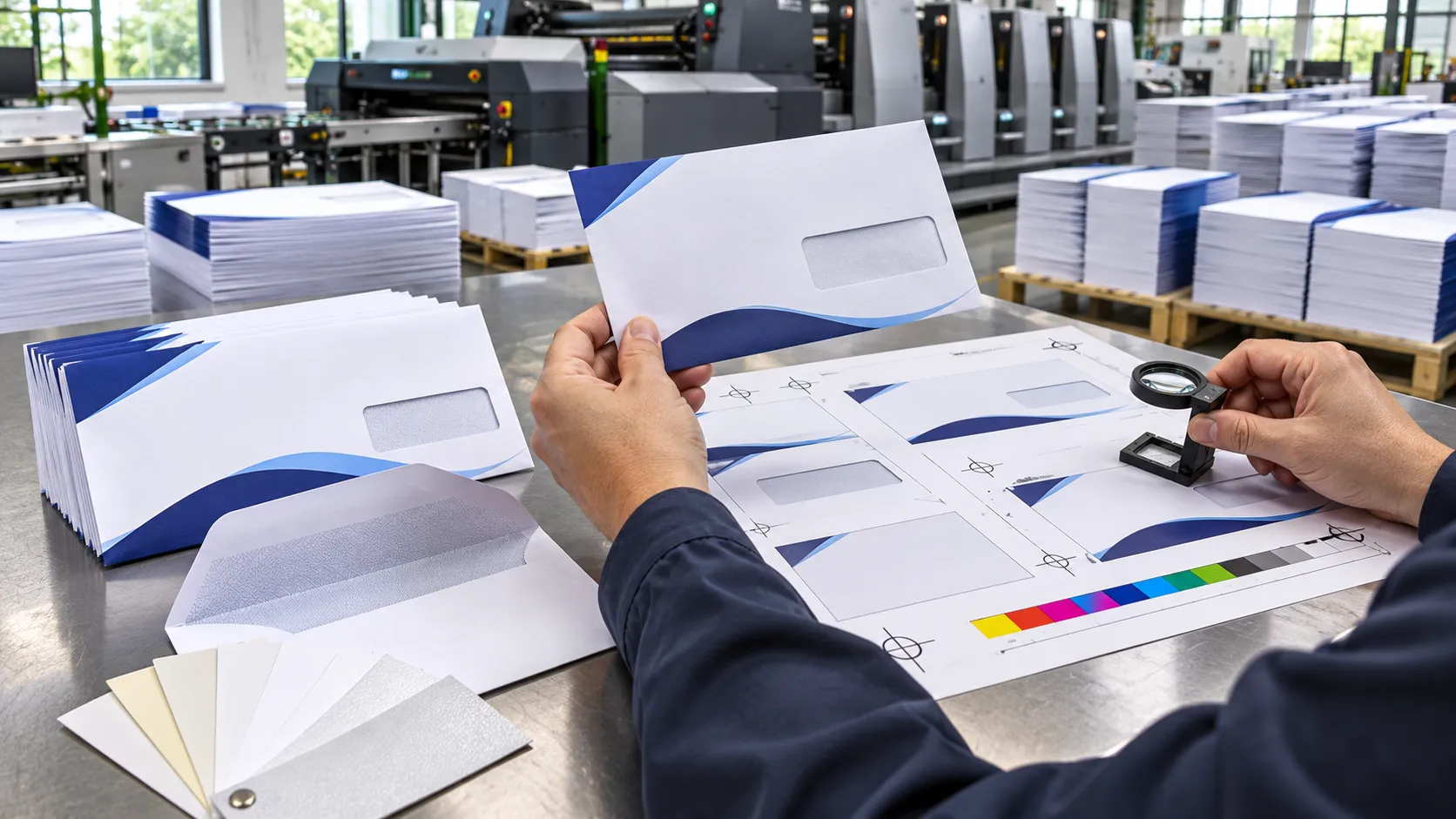
Identify whether the logo is correctly positioned and the correct dimensions. Ensure the return address, typography, contact information, and gaps are easy to read. Verify the printing of your envelope logo. If you will be printing the envelope logo, you'll want to verify that the logo follows your brand standards before you print it. Ask the printer to give you either a CMYK color proof or a spot color proof depending on which kind of printing is needed.
This can be useful to help identify any discrepancies between the colours that you have approved and the actual printed colours. If ordering envelopes with business cards, letterheads, and business stationery, it's particularly important that the same color is used throughout all of them.
4. Review Artwork Bleed, Margins and Print Alignment
Though an envelope design may look perfect on-screen, artwork errors may affect your printed envelope. Always review the document size, bleed, safe margin and positions of all critical elements of your envelope printing artwork!
- Bleed: The decoration created outside the final cut edge. It prevents unwanted white edges when cut.
- Margins: make sure there is some space around the edge of the paper to avoid putting logos, addresses or any other vital information too near to the edge of the paper.
5. Check the Window Position and Address Visibility
Window envelopes are usually reserved for statement and invoice mail, official business correspondence, payment reminders, and all sorts of other mail. They are mainly used to display the recipient's address in an easy-to-read cutout versus the need to print another one.
When printing envelopes on a window, measure the window and align the address block on the document to be printed with the window.
- Avoid solely using digital design. Print out a sample letter, fold it to the same size you would like to send (for the actual mailing), and place it in the envelope.
- Test to see if the entire recipient address is visible in the window.
- Make sure that salient information is not located on the side of the window.
The correct alignment of envelopes helps to limit mail errors and makes handling documents easier.
6. Assess the Quality of Printed Samples and Physical Sample
Quality control of the envelope is critical to the product, and physical inspection of samples ensures quality throughout the process.
Please review the following:
- Compare the paper color to the approved sample.
- Ensure that everything- logos, images and the rest are placed and correct places.
- Pay special attention to the printing quality. There should not be any smudges or any other inconsistency.
- Another important parameter is the packaging. It should just be perfect.
- The seal used (adhesive) should be able to hold the flap securely.
A physical envelope print proof should be as good as possible as the intended print product. If ordering in large quantities or if you have a specific order, ask for a representative sample before confirming your order.
7. Resolve Quantity, Packaging and Delivery Specifications
Before placing bulk Envelope Printing Orders, talk with the provider about the following needs:
- Final order quantity (with any agreed production tolerances).
- Packaging Unit: Number of envelopes in a packaging unit.
- Protection due to moisture, dust, or physical damage to the package.
- Labelling (branch-wise/Department-wise if necessary).
- Accurate delivery addresses and contact information.
- Production Dates & Expected Delivery Dates.
- Criteria of inspection and acceptance of the completed order.
How to Approve an Envelope Printing Sample Before Mass Production
An appropriate approval process doesn't have to be overly complex. There are a few simple measures that businesses can take to minimise the risk of production mistakes.
- Step 1: Confirm the logo, text, colors, size, and design are accurate.
- Step 2: Review Technical Details Type of envelope; size; paper GSM; paper finish; type of flap; printer (offset or digital)
- Step 3: Test a physical sample: Bring in a piece of paper to test quality, color, cutting, folding, and finishing.
- Step 4: Do functional testing: Insert real business documents, test whether the address is displaying, and test adhesive closure.
- Step 5: Have it approved in writing If all is at the right level, scribble it off and send an e-mail or anything that is recorded.
Bulk Envelope Printing Approval Checklist
The given table talks about the checklift that needs to be considered before placing an order.
| Approval Requirement |
What to Verify |
| Envelope Size |
The dimensions and orientation of the documents, along with their compatibility. |
| Envelope Type |
Standard, window, or customized. |
| Paper GSM |
Specified paper weight and material. |
| Design and Branding |
Use of logo, typography, and brand colors. |
| Artwork |
Bleed settings, safe margins, and print alignment. |
| Address Layout |
Sender and recipient information. |
| Window Placement |
Verify window dimensions and ensure addresses are clearly visible. |
| Printing Quality |
Sharpness of cuts, ink coverage, and color consistency. |
| Physical Sample |
Fold, cut, glue, and closure quality. |
| Quantity |
Confirm the production quantity and acceptable tolerance. |
| Packaging |
Units per pack and protective packaging materials. |
| Delivery |
Delivery schedule and destination addresses. |
Retain approved artwork and technical specifications and physical samples for reference. If the envelopes delivered are not the same as agreed, these can help to resolve any differences.
Common Mistakes to Avoid Before Envelope Printing
Many businesses do not realize that there are mistakes they can make prior to the envelope printing process. Large orders can easily result in the overlooking of small details, even for procurement teams that are experienced.
- A frequent error is to approve a digital mockup and not a physical sample. This may result in variation in paper quality, color, and finishing that may be unexpected.
- Other common mistakes include using an incompatible document, not checking window alignment, choosing a paper GSM that is inappropriate, and failing to perform folding and adhesive tests.
- A few companies also don't address acceptable production tolerances and delivery specifications ahead of production. These are areas of potential disagreement when the actual amount/standard is not what was expected.
Having a documented approval process can prevent businesses from facing such problems.
Why Opt for Roz Ads for Bulk Envelopes Printing?
It is easier to deal with customized stationery needs and reorderings of stationery for companies if they partner with a company that has experience in such matters. Printing solutions from the Roz Ads are for businesses that want to have professionally designed envelopes, consistent branding, and bulk production. With digital and offset printing options, businesses can see key specifications before production. The artwork proofing and color verification options allow businesses to view key specifications before production. Talk to Roz Ads about your needs, whether it's for regular office envelopes or for customized corporate stationery; they can help you plan your next print order.
Conclusion
The right planning and the sample approval of envelopes are important prerequisites for successful envelope printing. Inspecting dimensions, paper GSM, artwork, branding, and window placement, as well as examining the physical print quality, can help to prevent reprinting expenses and avoid unnecessary errors for businesses. A well-documented approval process also guarantees that the products reached are conforming with the corporate needs. However, before placing your next Bulk Envelopes Printing Order, talk to Roz Ads about your print requirements and specifications.
Frequently Asked Questions
Please ensure the envelope size, the positioning of the logo, artwork alignment, brand colors, typography, window positioning, paper GSM, and return address are correct before approving the proof.
Yes. A physical sample assists in the verification of paper quality and document fit, folding, color accuracy, closure with adhesive, and address visibility prior to mass production.
However, it depends on the stage of the production. Changes after approval may add to costs and add to delays in delivery, and/or reprinting may be necessary.
Standard business letter paper would be around 75-90 GSM, but if you want something a little more luxurious, then 100-120 GSM paper is a good option.
Show reference colors of approved brands; ask for color proof. Make sure to review CMYK/spot-color specifications; review the actual sample with brand specifications.
Check the size of the envelope, type of envelope, GSM of paper, artwork, position of the artwork/logo, window position, number of printed sheets, packing, production schedule, and delivery conditions.